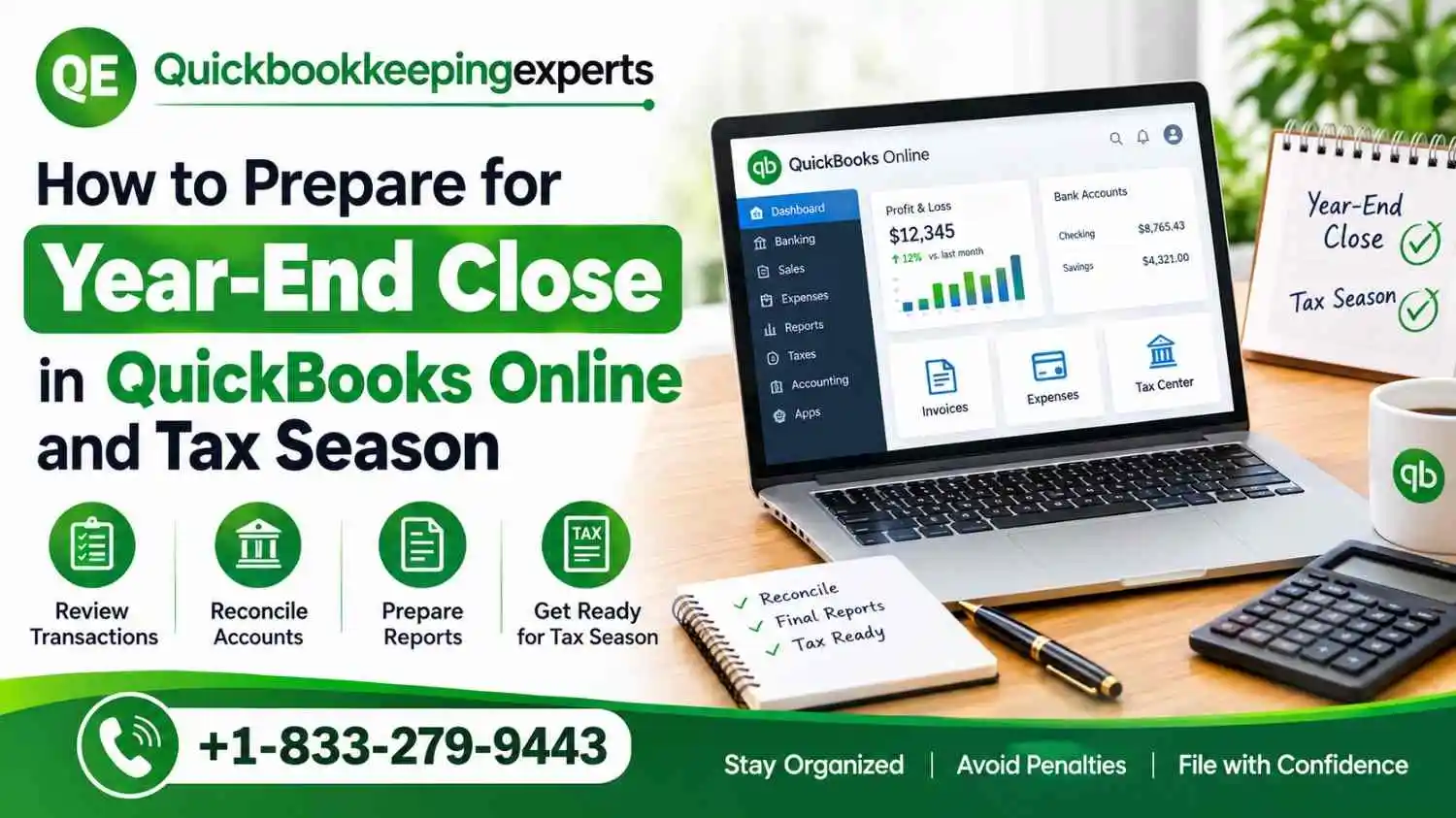
So, year-end is not just about running a Profit and Loss report or starting afresh with the new calendar? For a small business this is the point at which day-to-day bookkeeping needs to be converted into tax ready financial records.
Doing a proper year-end review will identify unclassified transactions, unreconciled accounts, open invoices, old bills or incorrect account classifications or payroll issues among other things that can affect financial reporting.
The steps in this QuickBooks Online year-end guide provide a concise closing roadmap, with practical advice on cleaning up transactions, reconciling accounts, reviewing financial reports and compiling information for your tax pro.
Note: Your financial year is not always the same as your calendar year Before we start, verify the fiscal-year settings and specify which reporting period you really would like to close.
The Year-End Closing Blueprint
Rather than working on a single task, think of year-end bookkeeping as a sequence:
‘Prepare → Clean Up → Reconcile → Review → Adjust → Verify → Tax-Ready → Close**
Each stage answers a different question:
Stage | Main question |
Prepare | Are you working with the correct financial period? |
Clean up | Are transactions complete and properly categorized? |
Reconcile | Do QuickBooks balances agree with your financial statements? |
Review | Do the financial reports make sense? |
Adjust | Are legitimate year-end adjustments needed? |
Verify | Can you explain unusual balances and transactions? |
Tax-Ready | Does your accountant have the information needed for filing? |
Close | Are finalized books protected from unnecessary changes? |
This sequence helps to better control QuickBooks Online year-end closing and decreases the probability of identify bookkeeping problems after tax preparation has begun.
Start with the Year-End Date, Not the Transactions
Then before you go into individual transactions, figure out for what period exactly are you preparing.
It may be a period of time: for instance, a business using a calendar year might examine January 1 – December 31. Use 2023 for a business with an alternative fiscal year.
Confirm your fiscal-year setting
In QuickBooks Online, go to:
Settings → Account and settings → Advanced→ Accounting
Check the First month of fiscal year setting.
Why this is important: Financial report relies on the reporting period you choose.
Why this comes first
In fact, imagine reviewing hours of transaction after transaction only to see that the report you have generated is for the wrong fiscal year.
Setting the right period to report on is our first step into successfully accessing verifiable data.
Build Your Year-End Document Pack
Collect the documents that will allow you to compare QuickBooks with real-world financial records, before you begin the detailed review.
Your year-end file should generally include:
- Bank statements
- Credit card statements
- Loan statements
- Investment or financing records, where applicable
- Payroll records
- Sales-tax records
- Receivable accounts information
- Accounts payable information
- Fixed-asset records
- Inventory records, if applicable
- Major purchase documentation
- Business expense receipts
- Prior-year financial statements
- Tax-related documents
- Accountant instructions or adjusting entries
This is one of the most useful habits in Year-end bookkeeping in QuickBooks Online because you are not reviewing QuickBooks in isolation.
You are reconciling the books with the substantiating evidence.
Read More: Fix Reconciliation Issues in QuickBooks
Clean the Transaction Queue Before Reconciliation
Reconciliation is only as good as the items coming into it.
Review outstanding bank-feed transactions before you perform an account reconciliation.
Look for transactions that are:
- Uncategorized
- Unmatched
- Duplicated
- Missing
- Assigned to the wrong account
- Posted to the wrong date
- Recorded in the wrong business account
- Personal transactions incorrectly treated as business expenses
Don’t categorize simply to make the list disappear
No need to categorize just for the sake of checking it off your list
Whatever actually happened, its how a transaction should be classified.
A payment to a credit-card company, for instance, might instead be regarded as an asset transfer than an expense. When you pay your loan, it consists of principal and interest. An owner’s personal withdrawal cannot be a business expense by default.
This phase is not a reduction to the number of transactions awaiting review, it is a focus on accuracy.
Reconcile Every Relevant Account
If you’re wondering what to do in QuickBooks Online at year end, reconciliation might be at the top of your list.
Perform natural match in QuickBooks with the actual transactions for:
- Checking accounts
- Savings accounts
- Credit cards
- Loans
- Other accounts that require reconciliation
So QuickBooks always ask to reconcile accounts time-to-time and fulfill required reconciliations before year-end. It means that your statement has to be used as the third party reference when verifying the QuickBooks balance.
The year-end reconciliation rule
The year-end reconciliation rule
Do NOT just settle up December then take it that the whole year is OK.
Work backwards cumulatively from the earliest unreconciled period if earlier months were never actually reconciled
Any errors in a previous reconciliation can impact the balances that show later on.
What should you look for?
Watch for:
- Missing transactions
- Duplicate transactions
- Incorrect beginning balances
- Uncleared transactions
- Incorrect transaction dates
- Transfers recorded incorrectly
- Bank fees missing from QuickBooks
- Transactions that were edited after reconciliation
In an ideal world, that reconciliation difference equals $0.00 before you fully call the account complete.
Read More: How to Reactivate an Account in QuickBooks
Review Accounts Receivable Before Calling the Books Finished
A Profit and Loss statement can appear okay while customer balances remain incorrect.
Perform an Accounts Receivable Aging Report and review unpaid customer balances.
Ask:
- Are these customers genuinely owing money?
- Are old invoices still collectible?
- Are any payments sitting incorrectly?
- Were customer payments recorded against the correct invoices?
- Are there duplicate invoices?
- Are credit memos being applied correctly?
- Are there deposits that have not been properly recorded?
Pay particular attention to very old balances
A five-year-old invoice appearing as an outstanding receivable deserves an explanation.
It might be:
- A legitimate unpaid invoice
- A payment that was never applied
- A duplicate transaction
- An accounting error
- A balance that needs accountant review
So please do not delete old receivables just because they seem odd?
Review Accounts Payable and Outstanding Bills
Then, look through what the company owes.
Run an Accounts Payable Aging and see open vendor balances.
Check:
- Old unpaid bills
- Duplicate bills
- Bills already paid outside QuickBooks
- Vendor credits
- Incorrect vendor assignments
- Bills recorded in the wrong accounting period
- Payments that were not matched correctly
This point is crucial as any outstanding liabilities will skew your year-end Balance Sheet.
Know this, if a bill has legitimately not been paid it should not be erased just because you want things to look nicer on the report.
Investigate Undeposited Funds and Outstanding Deposits
Undeposited Funds is an area that we may want to review.
A legitimate balance owing can be a balance of error, however if that balances reaches significant levels or is unusually old then it should not pass up the opportunity for investigation.
Ask:
- Are customer payments still waiting to be deposited?
- Were payments already included in a bank deposit?
- Was a bank deposit created correctly?
- Are transactions duplicated?
- Is the balance caused by an incorrect payment workflow?
QuickBooks’ year-end guidance specifically recommends reviewing outstanding deposits and the Undeposited Funds account as part of year-end preparation.
They may not force the account to zero be the target. Check that the remaining balance is explainable.
Review Credit Cards, Loans, and Other Liabilities
Liabilities usually don’t get much thought from business owners who are focused on checking accounts.
Review:
Credit cards
Reconcile the QuickBooks balance with the most current statement.
Business loans
Confirm that the balance of your principal is consistent with what the lender says you owe.
Accrued liabilities
Verify whether liabilities that are already known are recorded properly.
Payroll liabilities
Ensure that payroll-related balances does agree with back up payroll records and filed required forms.
Sales tax liabilities
For filed and unpaid sales-tax obligations, compare the balance in QuickBooks to the QBO.
We should not accept a liability account simply as correctly being one because it has a number. You must know what the number means.
Give the Profit and Loss Statement a “Reasonableness Review”
Now get out of the transaction-level bookkeeping and into the broader financial picture.
Generate a Profit & Loss report for the Full Year.
Look beyond the ultimate net-income.
Review the major categories.
Ask these questions:
Revenue:
Does total revenue look consistent with actual business activity?
Cost of goods sold:
Does the cost structure make sense for the business?
Payroll:
Does payroll expense agree with payroll records?
Rent and utilities:
Are recurring expenses complete and well-classified?
Software subscriptions:
Are recurring charges recorded correctly?
Travel and meals:
Are these expenses categorized appropriately?
Owner-related transactions:
Are Personal Expenses, Owner Draws, or Contributions Distinct from Operating Costs?
Such a big surprise in the books does not automatically entail error. This means that number is deserving of an explanation.
Use the Balance Sheet as Your Year-End Reality Check
One of the most powerful reports during QuickBooks Online year-end preparation is also one that is often neglected: your Balance Sheet.
Review:
- Cash
- Accounts receivable
- Inventory
- Fixed assets
- Accounts payable
- Credit cards
- Loans
- Payroll liabilities
- Sales-tax liabilities
- Equity
Use the “Can I explain it?” test
For every material Balance Sheet account, question:
> Can I explain what this balance represents and support it with documentation?
If the answer is no, investigate before finalizing the books.
Often that is worth much more than searching for a number that just “looks wrong”.
Review Fixed Assets and Major Purchases
Year-end is a good time to review significant business purchases.
Look for:
- Computers
- Machinery
- Vehicles
- Furniture
- Equipment
- Major improvements
- Other capital purchases
But not every purchase automatically constitutes as a capital asset, and the treatment can depend on both the facts and applicable tax rules.
If a larger purchase mistakenly been entered as an ordinary expense when it could be classified differently, flag it for your accountant.
Additionally, analyze the existing balances in fixed assets and accumulated depreciation.
Review Owner Contributions, Draws, and Equity
There are a lot of transactions that includes the owner when it comes to bookkeeping for small businesses which could be recorded incorrectly.
Review:
- Owner contributions
- Owner draws
- Personal expenses paid through business accounts
- Business expenses paid personally
- Equity accounts
- Partner distributions, where applicable
Consider some advice from Eric: Do not treat owner transactions like normal operating expenses, just because money left the bank account.
If the business has more than one owner or partners, allow the accountant to decide where appropriate as to how year-end will be treated.
Don't Forget Payroll and Employee Records
However, if payroll records are ignored, taxpayers have not finished preparing for tax season.
Review:
- Employee information
- Payroll transactions
- Payroll liabilities
- Payroll tax payments
- Payroll-related accounts
- Contractor payments
- Required year-end forms
Set the Payroll Year-End workflow for QuickBooks Online Payroll users and ensure that payroll records are complete prior to preparing taxes.
The approach to these balances depends on the particulars of each situation, but accountants and payroll professionals should consider reviewing unusual payroll liabilities rather than mission-forceful zeroing out balances without fully understanding what they are.
Review 1099 Information and Contractor Payments
If your business paid independent contractors, year-end is also the time to review contractor records.
Check whether:
- Contractor profiles are complete
- Vendor information is accurate
- Payments were categorized appropriately
- Reportable payments were recorded under the correct vendor
- Required tax information has been collected
Realistically however the specifics of the reporting requirement are contextualized based on associated with provider, recipient, type of payment and tax law in place at the time.
Hence, prepare the accounting information in QuickBooks but verify filing requirements with an experienced tax professional.
Review Sales Tax Before Finalizing the Books
Before putting your year-end bookkeeping to rest, if you operate a business that belief sales tax, review the sales-tax liability.
Compare:
Sales-tax collected → Sales-tax filed → Sales-tax paid → Liability balance
Investigate unusual differences.
You want to make sure that you are not programming an adjustment just so that the balance matches what is expected.
A difference may result from:
- Timing
- Incorrect tax codes
- Missing transactions
- Incorrect filing entries
- Payments recorded incorrectly
- Transactions posted to the wrong period
QuickBooks also includes year-end guidance on generating sales-tax returns and relating with a ProAdvisor/accountant when relevant.
Create a Year-End Financial Report Package
Once your bookkeeping has been inspected, generate the reports required by you or your accountant for your company.
A typical package may include:
Report | Why it matters |
Profit & Loss | Reviews annual income and expenses |
Balance Sheet | Reviews assets, liabilities, and equity |
General Ledger | Provides transaction-level detail |
Trial Balance | Helps identify account balances and adjustments |
A/R Aging | Reviews outstanding customer balances |
A/P Aging | Reviews unpaid vendor obligations |
Bank reconciliation reports | Supports reconciled account balances |
Sales-tax reports | Support tax reporting where applicable |
Payroll Reports | Supports payroll and tax review |
Fixed-asset information | Supports depreciation and asset review |
The specific reports you need vary on the business type and your accountant’s method of preparing taxes.
Compare This Year with Last Year
Here’s a simple review that can reveal issues quickly:
Current year vs. previous year
Compare:
– Revenue
– Gross profit
– Payroll
– Major operating expenses
– Accounts receivable
– Accounts payable
– Cash
– Debt
– Owner equity
This does not mean you are looking for the same exact numbers.
You’re looking for unexpected changes that need an explanation.
If for instance, an expense on advertisement led to a sudden spike in this year, again investigate.
In case of a drastic reduction in revenue, to check that the accounting records are complete.
What accounts receivable had a jump—are customers taking longer to pay or were invoices not input accurately.
Create a “Questions for the Accountant” List
Perhaps the most straightforward correction to implement in your QuickBooks Online year-end checklist for small business is ending the journey of trying to troubleshoot every outlying transaction on your area yourself.
Create a separate list containing items such as:
- Unusual expenses
- Large equipment purchases
- Old receivables
- Old vendor balances
- Loan changes
- Owner distributions
- Personal/business transactions
- Unusual journal entries
- Fixed-asset questions
- Depreciation questions
- Tax-related adjustments
This provides your accountant a clear place to begin.
It at the same time removes the very urge to fiddle around with unsupported modifications just because a number looks wrong.
Make the Books Tax-Ready—Not “Tax-Adjusted” Without Guidance
A key distinction occurs between preparing bookkeeping records for tax season and making your own tax adjustments.
Your responsibility may be to ensure that:
- Transactions are complete
- Accounts are reconciled
- Documentation is available
- Financial reports are accurate
- Contractor information is organized
- Payroll records are complete
- Questions are clearly identified
Your tax professional may then determine:
- Tax adjustments
- Depreciation treatment
- Deductions
- Accrual adjustments
- Tax classifications
- Other year-end entries
This separation helps prevent bookkeeping records from being changed simply to achieve an expected tax result.
Perform a Final “No Surprises” Review
Before considering how to close books for yearend in QuickBooks Online, perform one final review.
Ask:
Transactions
Are all significant transactions recorded?
Bank accounts
Are all relevant accounts reconciled?
Credit cards
Do statement balances agree with QuickBooks?
Receivables
Are old customer balances explained?
Payables
Are outstanding bills legitimate?
Payroll
Are payroll liabilities supported?
Sales tax
Are filings and payments reflected correctly?
Assets
Are significant purchases reviewed?
Equity
Are owner contributions and withdrawals properly classified?
Reports
Can you explain unusual changes?
Documentation
Does your accountant have access to the documents that support it?
Answering all of these is a lot more than reasonable; if your books meet the litmus test here, they are much closer to being tax-ready.
QuickBooks Online Year-End Checklist
This is your condensed checklist to use as your action sheet.
Before reviewing
[ ] Confirm fiscal-year dates
[ ] Collect bank and credit-card statements
[ ] Gather loan and financing statements
[ ] Organize payroll records
[ ] Gather sales-tax information
[ ] Organize contractor/1099 information
Clean up
[ ] Review uncategorized transactions
[ ] Review duplicate transactions
[ ] Match bank-feed transactions
[ ] Review transfers
[ ] Review personal/business transactions
[ ] Review Undeposited Funds
[ ] Review outstanding deposits
Reconcile
[ ] Reconcile checking accounts
[ ] Reconcile savings accounts
[ ] Reconcile credit cards
[ ] Review loan balances
[ ] Investigate reconciliation differences
[ ] Save reconciliation reports
Review
[ ] Run Profit and Loss
[ ] Run Balance Sheet
[ ] Review General Ledger
[ ] Review Trial Balance
[ ] Review A/R Aging
[ ] Review A/P Aging
[ ] Review fixed assets
[ ] Review equity accounts
[ ] Review payroll liabilities
[ ] Review sales-tax liabilities
Tax preparation
[ ] Review contractor payments
[ ] Organize 1099 information
[ ] Review payroll records
[ ] Gather tax documents
[ ] Identify accountant questions
[ ] Review potential year-end adjustments with your tax professional
Finalization
[ ] Compare current year with prior year
[ ] Resolve unexplained balances
[ ] Export/save required reports
[ ] Provide records to your accountant
[ ] Close the books after the review is complete
What Not to Do During QuickBooks Online Year-End Closing
When the goal shifts from accurate bookkeeping to making the reports look right at year-end cleanup, things start to get dangerous.
Avoid:
- Deleting old transactions just because they appear weird.
- Changing dates to force transactions into a particular year.
- Creating journal entries without understanding their accounting purpose.
- Writing off customer balances without checking that the balance is actually bad debt.
- Changing reconciled transactions casually.
- Forcing liability accounts to zero.
- Altering local tax designations without expertise
- Preparing massive year-end adjustments simply because last years numbers may not look the same.
- Note any ambiguity in a transaction and obtain clarification from the proper accounting expert.
When to Bring in an Accountant or Bookkeeping Professional
Some year-end tasks are routine. Some can have a significant impact on financial statements or tax filings.
For your business professional review is even more valuable when it has:
- Multiple owners
- Inventory
- Payroll
- Loans
- Fixed assets
- Significant equipment purchases
- Sales-tax obligations
- Large accounts receivable balances
- Complex contractor payments
- Prior-year bookkeeping errors
- Reconciliation discrepancies
- Significant year-end adjustments
Before tax preparation, a professional can also check if your bookkeeping is mirroring what the underlying business activity actually was.
Quick Bookkeeping Expert also provides expert help for businesses that are struggling to clean up QuickBooks Online, reconcile accounts, analyze bookkeeping records, provide year-end reports and prepare their books for a professional tax review.
FAQs
How do I prepare QuickBooks Online for year end?
To how to prepare QuickBooks Online for year end, first confirm your fiscal-year period, then clean up transactions, reconcile bank and credit-card accounts, review receivables and payables, check liabilities and equity, run financial reports, review unusual balances, and organize records for tax preparation.
What should I do in QuickBooks Online at year end?
If you’re wondering what to do in QuickBooks Online at year end, focus on completeness and verification. Review transactions, reconcile accounts, check A/R and A/P, review payroll and sales tax, verify financial reports, organize tax documents, and complete any appropriate accountant adjustments.
How do I close the year in QuickBooks Online?
How to close the year in QuickBooks Online relies on your business and accounting work process? Complete your year-end review first. After the financial information has been reviewed and necessary adjustments are complete, you can use QuickBooks Online’s closing-date settings to help prevent unintended changes to the finalized period.
Does QuickBooks Online automatically close the year?
QuickBooks Online handles year-to-year accounting differently from a traditional manual ledger closing process. However, that does not mean you should skip the year-end review. Your accounts still need to be reconciled, reviewed, and prepared for tax reporting.
Do I need to reconcile every account before year end?
Relevant bank and credit-card accounts should be reconciled so that the balances in QuickBooks can be compared with actual statements. If older periods remain unreconciled, address those periods rather than reconciling only the final month.
What reports should I run at year end in QuickBooks Online?
Common year-end reports include Profit and Loss, Balance Sheet, General Ledger, Trial Balance, Accounts Receivable Aging, Accounts Payable Aging, and reconciliation reports. Your accountant may request additional reports depending on your business.
What is the difference between year-end bookkeeping and tax preparation?
Year-end bookkeeping focuses on ensuring that the accounting records are complete, categorized, reconciled, and supported. Tax preparation uses those records to determine tax reporting and applicable adjustments. The two processes are related but are not exactly the same.
Is there a QuickBooks Online year-end checklist for accountants?
Yes. Accountants and QuickBooks Online Accountant users can use dedicated year-end workflows to review client accounts, reclassify transactions, prepare tax information, review payroll, and close books. The appropriate workflow depends on the client’s accounting setup and reporting requirements.
Can I make year-end adjustments myself?
Some routine bookkeeping corrections may be appropriate for a business owner or bookkeeper. However, tax adjustments, depreciation, complex equity transactions, unusual journal entries, and other accounting matters should be reviewed with a qualified accountant or tax professional.
Wrap Up
Closing QuickBooks Online year-end is not a magic “you hit one button to close my year” kind of process. It has to do with ensuring that the financials paint a clear and defensible story before those numbers make their way into tax preparation.
This QuickBooks Online year-end checklist is structured as prepare, clean up, reconcile, review, verify, document and close.
If you’re looking for a practical year end guide for QuickBooks Online, remember the central rule: Don’t finalize a number you cannot explain. A clean reconciliation, understandable Balance Sheet, reviewed Profit and Loss, organized tax documentation, and clear accountant handoff will make the transition into the new financial year much smoother.
Now let’s walk through the above workflow to demonstrate how it matches against QuickBooks current guidance on fiscal-year settings, year-end reports, bank reconciliation, outstanding deposits, A/R and A/P review including sales tax, reclassifications and closing the books.
The second question focused on accountant mode (QuickBooks currently has a dedicated year-end checklist/workflow for accountants, covering tools like Prep for taxes, reclassification, payroll year-end work, account adjustments and closing of client books).